Nanotheranostics in Multi-Organ Oncology: A Systematic Review of Pharmacological Advances Integrating Omics and Artificial Intelligence
Keywords:
- Nanotheranostics, Multi-organ oncology, Targeted drug delivery, Imaging-guided therapy, Multi-omics integration, Artificial intelligence, personalized cancer therapy, Stimuli-responsive nanoparticles, Bioinspired nanoplatforms, Precision oncology
Abstract
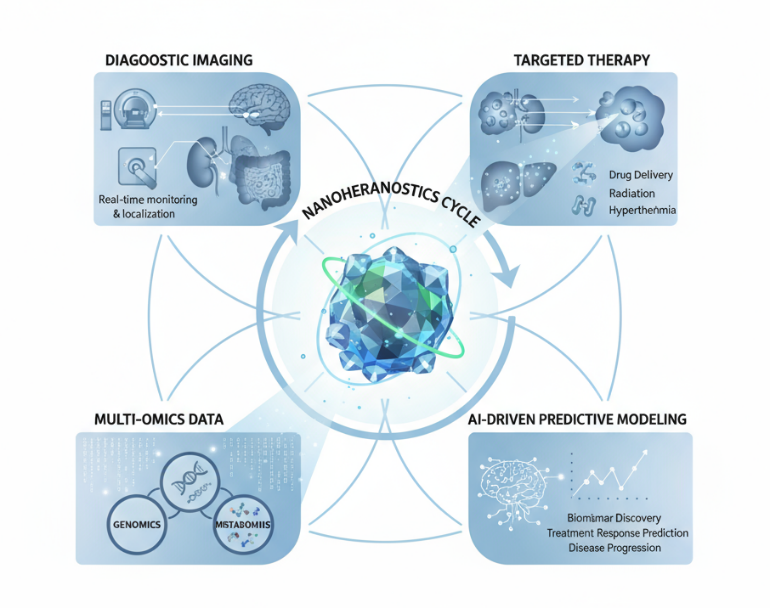
Background: Cancer continues to pose a major global health challenge, with liver, lung, pancreatic, breast, and brain tumors contributing substantially to morbidity and mortality. Conventional pharmacological approaches are limited by systemic toxicity, poor tumor specificity, and therapeutic resistance.Objective: This review systematically evaluates advances in nanotheranostics for multi-organ oncology between 2019 and 2025, emphasizing integration with omics technologies and AI-driven approaches.Methods: A comprehensive literature search was conducted across PubMed, Scopus, and Web of Science. Studies reporting preclinical and clinical nanotheranostic interventions were included, with data extracted on nanoparticle platforms, therapeutic and diagnostic mechanisms, omics integration, and AI applications.Results: Across all organs, multifunctional nanoparticles enabled simultaneous imaging and targeted therapy, with enhanced tumor specificity and reduced systemic toxicity. Integration of multi-omics data and AI-guided analytics facilitated patient-specific targeting, predictive modeling of therapeutic response, and adaptive treatment strategies. Organ-specific challenges, including the blood–brain barrier, dense stromal matrices, and molecular heterogeneity, necessitate tailored nanotheranostic designs. Emerging approaches such as stimuli-responsive and bioinspired nanoparticles show promise for precision oncology.Conclusion: Nanotheranostics, when integrated with omics and AI technologies, represent a powerful paradigm shift in multi-organ cancer therapy, offering personalized, adaptive, and precise interventions. Overcoming translational barriers and optimizing clinical implementation will be to realizing their full therapeutic potential.