Atrial Septal Defects (ASD), Atrioventricular Septal Defect (AVSD), Ventricular Septal Defects (VSD), Patent Foramen Ovale (PFO): AI Echocardiography, Diagnosis, Biomarkers, Epidemiology, Pathophysiology, Etiology, ML, Heart Transplant
Keywords:
- Septal Defects; AI Echocardiography; Machine Learning; Cardiac Biomarkers; Congenital Heart Disease; Risk Prediction.
Abstract
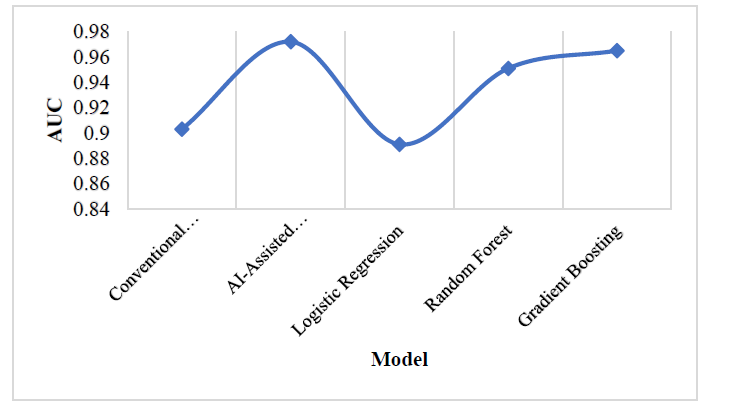
Different anatomical and clinical presentations are observed among congenital septal defects such as ASD, AVSD, VSD, and PFO. In this retrospective study, 320 patients have been analyzed in terms of clinical characteristics, biomarkers, AI-assisted echocardiography, and ML-based prediction models. In order to perform the analysis of clinical and echocardiographic parameters, descriptive statistics, ANOVA test, logistic regression analysis, and ML algorithms were used. Among these septal defects, AVSD demonstrates the highest haemodynamic load with larger defects, high levels of BNP/NT-proBNP, pulmonary hypertension, and low ventricular function. AI-assisted echocardiography is more effective compared to classical evaluation with 96.2% of diagnostic accuracy, 95.6% of sensitivity, and AUC = 0.972. The best-performing ML model is gradient boosting, which shows 95.0% of accuracy and AUC = 0.965. The elevated levels of BNP/NT-proBNP, poor ventricular function, and pulmonary hypertension significantly predict poor outcomes (p < .001). These results confirm that AI-assisted echocardiography, biomarkers, and ML-based predictions are effective approaches for diagnosing and risk stratifying congenital septal defects.