Microwave-Assisted Synthesis of Heterocyclic Scaffolds for Antioxidant Activity
Keywords:
- Microwave-assisted synthesis; Heterocyclic compounds; Antioxidant activity; Free radical scavenging; Structure–activity relationship (SAR)
Abstract
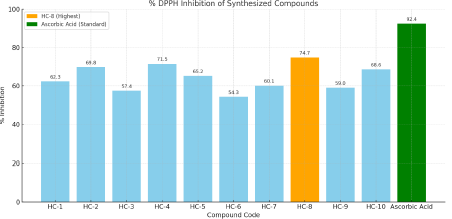
This paper gives an overview of the formation of heterocyclic scaffold utilizing microwave-aided organic synthesis (MAOS) technique and defines the antioxidant potential of these synthesized scaffolds using in vitro assays. Ten heterocyclic compounds (HC-1 to HC-10), of derivatives of pyrazoles, thiazoles, imidazoles and oxadiazoles were prepared by utilizing equimolar mixtures of the starting materials at optimized microwave conditions. Confirmation of structural characterisation was established through FTIR, 1H NMR and MS. Antioxidant potential of individual compound was measured by DPPH, ABTS and FRAP assays. The strongest antioxidant agent was found to be HC-8 with the maximum radical scavenging activity and minimum IC 50 in all the tests and it is probably because of having a hydroxylated aromatic ring. The result of a statistical analysis established major differences in the activity between the compounds and there was an inverse proportional relationship between the antioxidant activity of the compounds and IC50. The results demonstrate the effectiveness of the microwave-assisted synthesis regarding the synthesis of biologically active heterocycles and speak to the potential of the molecule HC-8 as a lead molecule towards the development of antioxidant drugs.